
When everyone is busy, is staffing the problem?
It is half past six on a Thursday, and the lights are still on at the front desk. Two coordinators are working through referrals that should have been called yesterday. A nurse is finishing notes from the morning clinic, and the practice manager, who meant to leave an hour ago, is answering the phones. At the next leadership meeting, someone says what everyone is thinking: we need more people.
Sometimes that is exactly right. Often it is only part of the answer. A staffing problem exists when an organization lacks enough appropriately skilled, available people to deliver its workload safely and reliably. A workflow problem exists when the design, sequence, allocation or supporting conditions of the work create avoidable delays, rework or effort. Both can occur at once, and from the front desk at half past six they look almost identical.
This guide is for practice owners, administrators and clinical operations leaders who need to tell healthcare staffing and workflow problems apart before committing money, recruitment time and management attention to a fix. It explains why workload complaints rarely identify their own cause, what a nursing time-and-motion study revealed when the work was actually observed, and a seven-step method for testing the competing explanations.
One caution belongs at the start. Where patient safety is at immediate risk, protective action comes first, whether that means extra cover, agency staff or a temporary reduction in service. Diagnosis is for the decisions that follow, not a reason to wait.
Short on time? Read the TLDR version.
If the pressure in your organization sounds familiar, it may be one of the patterns described in 7 Signs Your Healthcare Organization Has Outgrown Its Operating Model. This article picks up where that one leaves off: having recognized the strain, how do you find out what is causing it?
Why workload complaints do not tell you the whole story
Workload pressure is a real and important signal, but it describes how the work feels, not why it feels that way. When a team says it cannot keep up, leaders hear a conclusion. What they have actually received is a symptom that several different causes can produce.
Five contributors are worth separating:
Demand. More work is arriving, or the work arriving is more complex than it used to be.
Staff capacity. There are not enough safe, competent, available staff-hours for the work.
Workflow design. Tasks take more steps, more waiting or more rework than they need to.
Role allocation. Work sits with people whose expertise it doesn’t require, while specialized work waits.
Operating conditions. Equipment, layout, data, technology, governance or management rules limit how fast work can move.
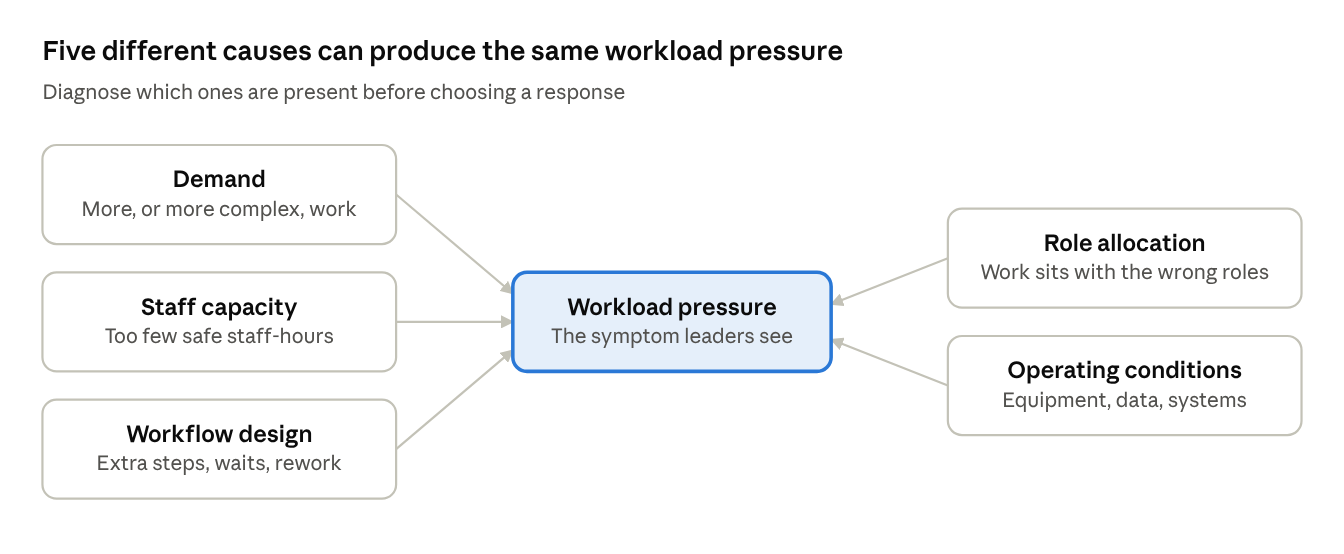
Why healthcare teams become overloaded — five contributing causes
The same complaint, “we can’t keep up,” can come from any of these causes, and often from more than one at a time.
Consider a referral backlog. It might reflect too few coordinator hours. It might equally reflect referrals arriving without the information needed to act on them, unclear responsibility for follow-up, slow responses from specialists, or all of these at once. Each cause calls for a different response, and hiring a second coordinator fixes only the first.
The Agency for Healthcare Research and Quality describes workflow as the sequence of physical and mental tasks carried out by different people, within and between work environments. That definition matters here. Workload pressure rarely lives inside one person or one role. It lives in the connections between them: the handoff, the missing form, the system that does not talk to the next one.
This is the shift in perspective that makes diagnosis possible. The issue is often not that a team is working too little. It is that the operation is asking people to compensate for workflows, routines or tools that no longer fit the volume and complexity it now carries. Organizations that are adding patients, providers or services often find that arrangements designed for a smaller operation start to show their limits in exactly this way.
If you are weighing a hiring decision against a workflow review right now, it can help to talk through what is driving the pressure before committing to either.
What a nursing time-and-motion study revealed about workload
BHS was asked to examine nursing workload in a private hospital in the Caribbean. The nurses were stretched, and the instinctive reading was that the hospital needed more of them. Rather than start from that conclusion, the team set out to watch how the work actually moved.
The study ran across 12 shifts over three days. It combined three sources of evidence: movement tracking, observation of tasks by a third party, and a survey of the nurses themselves. Together they showed where time went, how far people walked, how documentation fitted into the shift, and which tasks reached completion while the observers were present.
Three findings stood out:
Documentation was a large share of the work. Charting and documentation made up 27% of observed activities. That is a share of activities counted, not necessarily 27% of nursing time.
Not every task reached completion within the observation window. Around 60% of observed tasks were recorded as completed under the study’s method. The rest may have been finished later, handed to a colleague, or deferred. The figure does not mean 40% of patient care was missed.
Leaving the workstation mattered. Tasks that required a nurse to leave and return to the workstation were associated with a 43% lower likelihood of completion. This is an association worth investigating, not proof that movement caused tasks to go unfinished.
When a nurse’s workload is measured only by the number of patients assigned, leaders can miss the sources of pressure that sit around the bedside rather than at it: documentation, walking, interruptions, equipment that is not where it should be, and handoffs that arrive incomplete.
What followed is the instructive part. The findings did not point to a single answer. BHS recommended a combination: simpler documentation processes with a move toward digital charting, mobile workstations, changes to the physical arrangement of the workspace, appropriate delegation of non-clinical tasks, and adjustments to staffing and scheduling. These were recommendations from a completed study, not measured results after implementation.
The study’s limits deserve equal honesty. Three days in one hospital cannot describe nursing workload elsewhere. It did not show that the hospital was adequately staffed, and it did not establish that any single change would save a particular amount of time. What it did show is that observation surfaced several distinct causes that a headcount discussion would have collapsed into one.
Independent research points the same way. A 2023 time-and-motion study of acute and subacute medical wards observed 21 nurses performing 7,240 recorded tasks, with 556 interruptions concentrated during documentation and medication-related work, and about a third of nursing time spent on direct patient care. Different setting, similar lesson: measuring the work, and listening to the people doing it, reveals more than the complaint alone.
Five signs of healthcare workflow problems behind the pressure
Workflow problems tend to leave fingerprints. None of the five signs below proves that staffing is adequate, but each suggests that some of the effort a team is spending is being absorbed by the design of the work rather than by the work itself.
Work is repeatedly entered, checked or corrected
Rework is the quietest consumer of capacity. Demographics typed twice into different systems, claims returned for missing details, referrals sent back for incorrect information, patients phoned three times to confirm the same appointment. Each instance takes minutes; together they take hours. The useful question is: how much of today’s workload exists because an earlier step was incomplete or wrong?
Work repeatedly waits between people or departments
Work that stops between hands often looks like a staffing shortfall at the point where it piles up. A discharge is clinically ready but billing is not. A referral is sent but nobody is tracking it. An order sits awaiting clarification, or a patient is ready for rooming while nobody knows which room is free. Ask where the work stops, and who knows that it has stopped.
Specialized staff perform work that could be allocated differently
Clinicians chasing paperwork, nurses searching for supplies, and practice managers spending most of the day covering routine tasks are all signs that skilled time is being spent below its level. The American Academy of Family Physicians suggests practices start by reviewing existing staff and resources and rethinking who does what before adding roles. Delegation still has limits: any reassignment of clinical work depends on competence, supervision and the scope-of-practice rules that apply locally.
Workload is unevenly distributed
When one person, one shift or one hour of the day is overwhelmed while others are not, total headcount may not be the issue. Look at arrival patterns, patient acuity, appointment templates, shift overlaps and skill mix. In a multi-provider dental practice, for example, a schedule that looks fully booked can still leave capacity unused through cancellations, broken appointments, weak follow-up and uneven provider utilization. A full-looking diary and an access problem can coexist.
Workarounds have become normal practice
Sticky notes on monitors, spreadsheets kept beside the main system, unofficial chat threads, handwritten logs. Workarounds are a sign of conscientious staff filling a gap. They usually mean a workflow was never fully designed, the technology does not fit the work, or nobody owns the process end to end. They also hide the true workload, because the effort they consume rarely appears in any report.
When the evidence points to a genuine staffing problem
Workflow analysis must never become a polite way of postponing necessary hiring. Some organizations are simply short of people, and no amount of process redesign will make an unsafe roster safe.
The patient-safety evidence is clear on this point. AHRQ’s Patient Safety Network describes a well-established link between the adequacy of hospital nurse staffing and outcomes such as mortality and failure to rescue, and identifies staffing levels, work environment and teamwork as the most consistent predictors of missed nursing care. In 2025, AHRQ’s Making Healthcare Safer series published a rapid review dedicated to nurse staffing shortages that compromise patient-to-nurse ratios, treating them as a safety issue in their own right. The evidence for particular staffing interventions is more mixed, but the case for adequate staffing is not.
Signs that point toward a real staffing deficit include:
demand or patient acuity that consistently exceeds safe available capacity;
required clinical coverage or skill mix that cannot be filled;
persistent vacant shifts or specialist posts;
workload that stays excessive even after the major inefficiencies are controlled;
essential care that is repeatedly missed, or overtime that has become unsafe;
new services or higher volumes that need capabilities the team does not have.
It also helps to name the kind of staffing problem, because each calls for a different response. A temporary absence needs cover. A persistent vacancy needs recruitment and retention. An inadequate establishment, where the approved number of posts is too low for the work, needs a budget and planning decision. A skill-mix mismatch needs different people, not necessarily more of them.
When the safety signals are present, act on them now and investigate the longer-term causes alongside. The two are not alternatives.
How to tell a staffing problem from a workflow problem before committing to a solution
The method below is a sequence of seven questions. Each one narrows the field of explanations, and none requires specialist software. What it does require is patience: the willingness to keep looking after the first plausible answer appears.
Step 1: Define the actual performance problem
“Staff are overwhelmed” cannot be measured. Replace it with something observable: the referral team has a growing queue awaiting first contact, and the share completed within the agreed standard is falling. Record the intended standard, the group affected and today’s baseline. Everything that follows is tested against this statement.
Step 2: Quantify demand and how it varies
Measure the work arriving: its volume, its type, its complexity or acuity, its peaks across the day and the week, and the backlog already waiting. Resist using patient numbers as a stand-in for workload. Twenty routine follow-ups and twenty complex new referrals are not the same day’s work.
Step 3: Establish safe available capacity
Compare rostered coverage with actual coverage. Note the required skill mix, any legal or clinical staffing minimums, absences, and the competing duties that pull people away from the work in question. The gap between nominal capacity, the hours on paper, and usable capacity, the hours that can actually be spent on this work, is often where the first surprise sits.
Step 4: Map the current workflow
Start at the trigger that creates the work and follow it to confirmed completion. For each step, record:
who does it;
what system or information they use;
what happens next;
how long the work takes, and how long it waits;
where errors or exceptions occur;
who owns the work when it is incomplete.
AHRQ’s workflow toolkit recommends swim-lane flowcharts, which place each role in its own lane so the handoffs between them become visible, and suggests validating the map with the people who actually do the work.
Step 5: Observe the work where it happens
A map drawn in a meeting room shows how people believe the work flows. Observation shows how it does. Use short timed observations, task diaries, staff interviews, queue reviews, EHR activity data and direct walk-throughs, as appropriate. Involve frontline staff from the start, explain the purpose, and protect patient confidentiality throughout. Watch for movement, handoffs, duplication, interruptions, unavailable equipment, and idle time caused by waiting on someone else.
Step 6: Test the competing explanations
For each candidate cause, ask what evidence would confirm or rule it out. Would more staff-hours clear the queue, or would new staff meet the same missing information and the same unanswered calls? Is the bottleneck in one role, one time of day, one system? Treat every cause as a hypothesis until the evidence supports it, and do not stop at the first one that sounds right.
Step 7: Select and test a proportionate response
Some problems need hiring. Others need work reallocated, technology changed, a process standardized, schedules redrawn or management rules clarified. Compound problems may need several of these, sequenced by risk and dependency. Whatever you choose, test it on a bounded part of the operation before rolling it out.
A decision framework for staffing, workflow and capacity problems
The table below links what you observe to what you should investigate and the response it most often points toward. It is a practical aid for interpreting evidence, not a validated staffing algorithm, and it does not replace clinical staffing rules or professional requirements.
[TABLE]
What you observe | What to investigate | Likely response
Sustained high demand, an efficient workflow, not enough safe staffed capacity | Volume, acuity, coverage, skill mix | Additional staffing, adjusted coverage, or a change in service commitments
Manageable demand with repeated duplication, waiting or rework | Task and handoff design | Workflow redesign and standardization
High demand and inefficient processes together | Both staffing sufficiency and process waste | Protect safe staffing while improving the workflow
A bottleneck concentrated in one specialized role | Skill requirements and task allocation | Delegation, role redesign or targeted recruitment
Delays that vary sharply by time of day | Arrival patterns, schedule templates, how coverage is distributed | Matching capacity to demand; scheduling changes
Work that stops because equipment or information is unavailable | Environment, technology, integration, support | Remove the operating constraint
The answer can change once the first intervention lands. A redesigned workflow may reveal a staffing deficit that inefficiency had been masking. New staff may expose coordination problems that a smaller team managed informally. Treat the diagnosis as something to revisit, not a verdict delivered once.
How to improve the workflow without creating new problems
A change made under pressure can move the burden rather than remove it. Six disciplines keep workflow improvement honest.
Choose a bounded improvement. Pick one workflow, team, service or shift where a change can be tested safely, rather than redesigning everything at once.
Protect the core. Before anything changes, name what must not slip: essential clinical coverage, patient safety, response times, quality, and safeguards on staff workload.
Assign ownership. Name the operational owner, the frontline participants, the person who approves the change and the person responsible for measuring it. A change nobody owns tends to fade.
Prioritize by consequence. Address blockers first, meaning anything that threatens safety or essential capacity. Then pursue accelerators that unlock wider value, and leave optimizations for later.
Test, learn and adjust. Run a short pilot and watch real adoption. A new procedure written down is not the same as a new procedure in use.
Measure across the whole team. An apparent gain in clinician time can be paid for by new work for nurses, reception or support staff.
The Institute for Healthcare Improvement offers a useful structure for that last point. It recommends combining outcome, process and balancing measures and tracking a few of them over time. Outcome measures show whether the problem improved, process measures show whether the change is happening as designed, and balancing measures show whether the change caused trouble somewhere else.
This is the territory of BHS’s Healthcare Operations & Systemization work: helping organizations strengthen workflows, roles, handoffs, SOPs and management routines, then build and test the changes so they hold up in daily practice.
Common mistakes when diagnosing workload pressure
Treating hiring and workflow redesign as rivals. In many organizations the answer is both, in a particular order.
Using patient count as the measure of workload. It ignores complexity, documentation, coordination and the walking in between.
Asking staff to work faster. The goal is safer, more reliable work with fewer avoidable obstacles, not more speed from the same people.
Assuming technology saves time by default. A new system can add steps, exceptions and training load, so it needs the same scrutiny as any other change.
Delegating clinical tasks without safeguards. Competence, supervision, scope of practice and the applicable law decide what can be reassigned.
Declaring success at go-live. A documented process is not yet a functioning one; adoption has to be checked.
A practical checklist for your next workload review
Use these ten questions as a starting point for investigation. They are not a validated staffing assessment, and clinical staffing rules and professional requirements still apply.
If working through these questions raises more uncertainty than it settles, that is often the point at which an outside view helps. Understanding what’s causing operational strain? BHS helps healthcare organizations examine workflows, staffing-related constraints, role responsibilities, management routines and operational data to find what is limiting performance and where improvement should begin. book a 20-minute conversation about your operational challenges.
Treat workload as an operating-system question
Go back to the front desk at half past six. The team there might need another coordinator. It might need referrals that arrive complete, a clear owner for follow-up, a schedule that matches the afternoon peak, or a system that stops asking for the same information twice. Quite possibly it needs several of these at once.
When healthcare teams are under pressure, the question is not simply how many people are working. Leaders also need to understand what work is arriving, how it moves, where it gets stuck, and whether staff have the time, tools, skills and authority to complete it safely. That is how a workload complaint becomes a useful operating decision.
If your organization is growing faster than its routines and you want a second view before deciding between hiring and redesign, book a 20-minute conversation with BHS.
Frequently asked questions
How do I know if my practice has a staffing problem or a workflow problem?
Compare demand with safe, usable staff capacity, then map and observe how the work moves. If capacity falls short even when the workflow is efficient, the problem is mainly staffing. If demand is manageable but work waits, repeats or sits with the wrong roles, the problem is mainly workflow. Many organizations have both.
Will hiring more staff fix healthcare workflow problems?
Not on its own. New staff inherit the same handoffs, rework and missing information as the people already there, so the pressure often returns. Hiring helps most when it follows, or runs alongside, changes to how the work is designed.
What is a time-and-motion study in healthcare?
A time-and-motion study observes staff as they work and records what tasks they perform, how long those tasks take, how often they are interrupted and how far people move. It turns impressions of workload into evidence about where time and effort actually go.
Should we delay hiring until a workflow review is finished?
No, not when safety is at stake. If essential care is being missed, coverage is below required levels or overtime has become unsafe, take protective action straight away and run the review alongside it.
What should we measure after changing a workflow?
Track one or two outcome measures, such as backlog or time to completion, a few process measures showing whether the new workflow is being followed, and at least one balancing measure to catch new burden falling on another team.
Sources
AHRQ Workflow Assessment for Health IT Toolkit: What is workflow?
AHRQ Workflow Assessment for Health IT Toolkit: Flowchart (swim lane)
Kramer et al., Understanding the workflow of nurses in acute and subacute medical wards: a time and motion study, J Clin Nurs, 2023
AAFP, Taking Team-Based Care to the Next Level, FPM, 2022
AHRQ PSNet, Missed Nursing Care (primer)
AHRQ, Acute Care Nursing Staff Shortages That Compromise Patient-to-Nurse Ratios, rapid review, 2025
IHI, Model for Improvement: Establishing Measures
BHS, Case Study: Driving Efficiency Through Operations Research (internal; client anonymized)