It is seven-forty on a Monday morning, and the owner’s phone has already buzzed eleven times. A provider wants Thursday’s schedule changed. The front desk is unsure whether a patient qualifies for a refund. A supplier has shorted the order again, and someone needs to decide what to do about it.
By most outside measures, the organization is doing well. Patient volume is up. Two providers joined this year, a new service launched in the spring, and revenue is climbing. Yet the people running it feel less in control than they did when it was half the size.
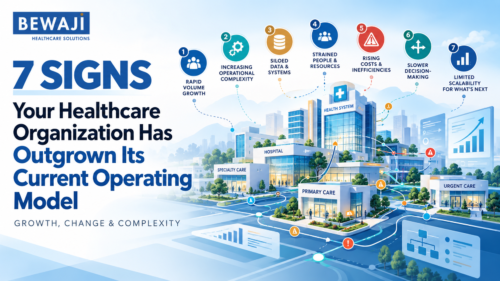
That gap between growth and control is often the first sign that a healthcare organization has outgrown its operating model. The organization has become more complex than the roles, workflows, decision rules and management routines it runs on. This article sets out seven warning signs, explains how to tell a passing problem from a structural one, and offers a practical sequence for what to do next.
Short on time? Read the TLDR version.
Why more staff, software or SOPs may not solve the problem
When strain appears, leaders reach for the familiar remedies. We need more people. We need better people. We need another system. We need more SOPs. Each of those can be the right answer, and each can also treat a symptom while the underlying cause carries on undisturbed.
The issue is often not that the team is working too little. It is that the operation is asking people to compensate for workflows, routines or tools that were built for an earlier stage. Growth does not always create the weakness. More often, it exposes systems that were perfectly workable at ten staff and one site, and are no longer sufficient at thirty staff and two.
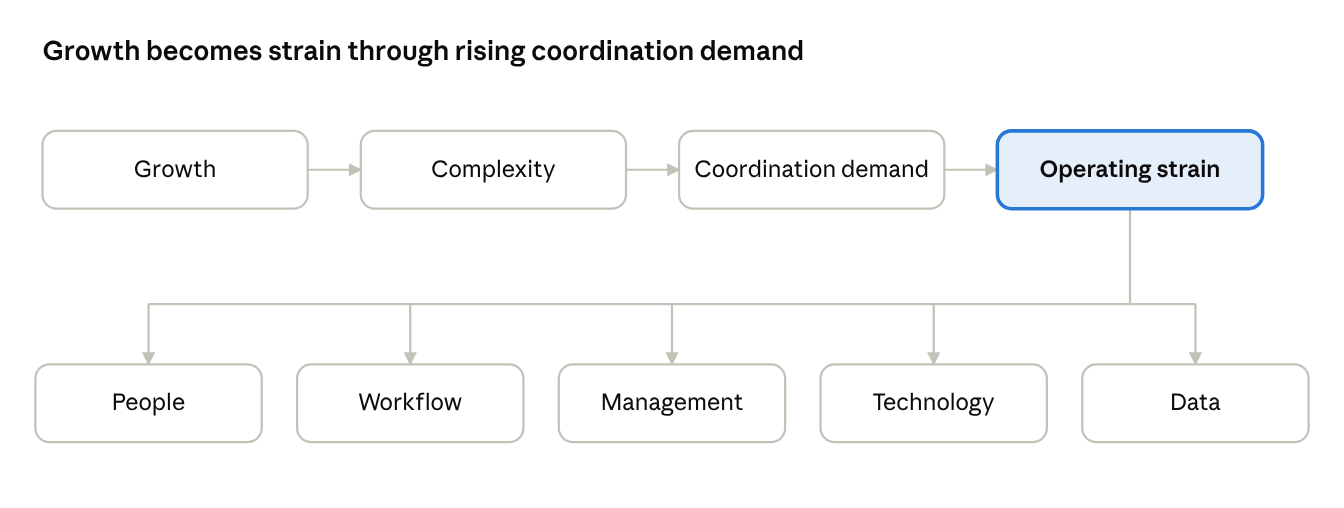
Growth exposes operational strain — 4 stages, 5 areas
Growth adds complexity, complexity raises the demand for coordination, and when the operating model cannot meet that demand, strain spreads across people, workflow, management, technology and data.
What is a healthcare operating model?
A healthcare operating model is the way an organization is set up to deliver care and run the business, reliably, day after day. It is less a document than a set of working parts that have to fit together:
- Roles and responsibilities: who does what, and who owns the outcome
- Workflows: how recurring work moves from trigger to completion
- Decision rights: who can decide what, without asking
- Management routines: the regular reviews, huddles and follow-ups that keep work on track
- Information: what leaders and staff can see, and when
- Tools and technology: the systems the work runs through
- Standards and accountability: what “done well” means, and who answers for it
- Feedback mechanisms: how problems surface and get fixed
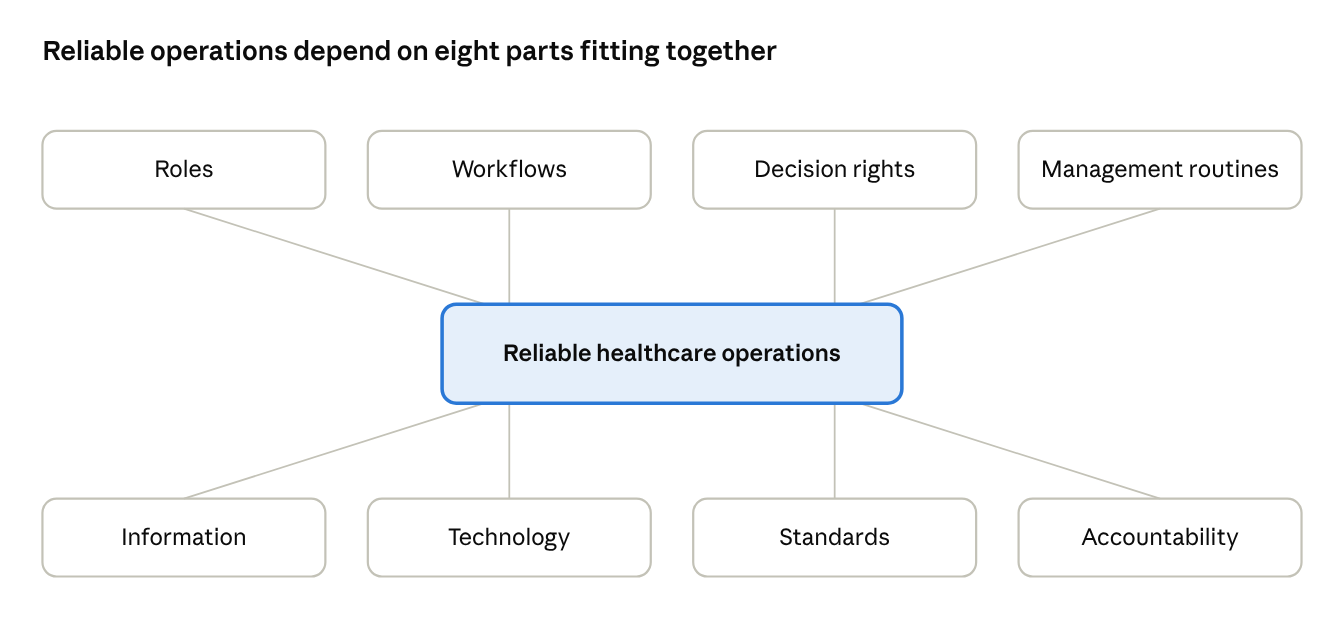
What makes up a healthcare operating system — 8 parts
Weakness in any one part shows up as strain everywhere else, which is why the symptoms below tend to travel together.
An organization can have SOPs, modern software and experienced staff and still have a weak operating model. Documentation describes how work should happen. It does not, on its own, create operational control.
No single symptom below proves that an organization has outgrown its operating model. But when several of these patterns appear together, leaders should look beyond the individual problems and examine how the organization itself is being coordinated.
Sign 1: Too many routine decisions still depend on the owner
Routine issues keep finding their way to the founder, physician-owner, CEO or senior administrator. Schedule changes, refunds, staffing gaps, purchasing, vendor problems, complaints and exceptions all arrive at the same desk. Over time the leader becomes the organization’s informal routing system, and every decision waits for a gap in their day.
Owner dependence is rarely a simple failure to delegate. More often the organization lacks the structure that makes delegation safe: clear decision rights, managers with real authority, defined escalation thresholds, procedures people can find, and information that lets someone else decide well. Without those, staff escalate because escalating is the only safe choice.
BHS has seen this pattern first-hand. In work with a multi-provider healthcare practice, documenting processes was not enough to reduce dependence on the owner. The practice also needed a stronger management layer, with clearer decision rights, recurring management routines and accountability for day-to-day operating outcomes.
A useful starting point is to sort common decisions into three categories:
- Decide: the manager handles it independently
- Consult: the manager seeks input but keeps responsibility
- Escalate: leadership approval is required
Diagnostic question: If the owner disappeared for two weeks, which routine decisions would stop moving?
If that question is uncomfortable to answer, particularly with expansion ahead, it may be worth taking time to talk through the operating model for the next stage before the load grows heavier.
Sign 2: The same work is done differently depending on who does it
Patients get a different experience depending on the location, the shift, the provider or the staff member they happen to meet. Booking works one way at the front desk and another on the phone. Follow-up depends on who remembers. Insurance verification, complaint handling and inventory checks vary from person to person.
At a small scale, informal coordination covers the gaps. People ask each other, the owner notices problems, and new staff learn by watching experienced colleagues. As the organization grows, teams get larger, new hires arrive faster, sites separate and leaders can no longer see every process for themselves. Informal knowledge stops scaling.
This is where the difference between an SOP and an operating system matters. A documented process becomes part of the operating system only when it also has a trigger, a named owner, defined roles, decision rules, exception handling, an escalation path, a measure, the right tools, training and a regular review. Without those, the SOP sits in a folder while the work carries on as before.
Not every process should be standardized. Clinical and professional work often requires judgment, and good organizations protect it. The target is unnecessary operational variation, especially where it creates patient risk, delays, rework, confusion, poor service or financial leakage.
Diagnostic question: Which recurring processes would produce noticeably different results if three different employees performed them tomorrow?
Sign 3: Growth is creating more work than the organization can coordinate
The organization is busy and growing, yet harder to manage each month. Tasks stay half-finished. Handoffs are missed. Staff spend their days following up with each other, and work disappears between departments. Patient issues need repeated chasing, and important tasks live in WhatsApp threads, inboxes and memory.
Growth adds more than volume. Every new provider, location, service, payer, system or partner adds relationships and dependencies that someone has to manage. The arithmetic is unforgiving: five people who need to coordinate share ten possible working relationships, while fifteen people share 105. Coordination load rises much faster than headcount.
Organizations also have a finite transition capacity, the amount of change they can absorb at once. It draws on leadership bandwidth, staff capacity, decision speed, management capability, technology support, data readiness and the attention of the people involved. A good strategic opportunity can still arrive at a time when the organization cannot absorb it safely.
Watch for these signs of overloaded transition capacity:
- Meetings multiply while decisions slow
- Implementation deadlines keep moving
- One manager is responsible for several major initiatives
- Staff are trained on new systems before earlier changes have settled
- New initiatives start faster than old ones finish
- “Temporary” workarounds quietly become permanent
Diagnostic question: How many major changes are currently competing for the same leaders, managers and frontline staff?
Sign 4: Managers solve recurring problems instead of managing performance
Managers spend their days filling staffing gaps, answering routine questions, fixing the schedule, chasing unfinished tasks and resolving the same complaints they resolved last month. When the clinic is short-handed, they step into frontline work. Performance reviews, coaching, workflow improvement and planning wait for a quiet week that never comes.
A manager who spends the whole day completing operational tasks may hold a management title without having the capacity to do management work. In the multi-provider practice described above, part of the work was turning an internal role into a true management layer, rather than simply naming someone the most senior administrative employee.
Management work cannot depend on the clinic becoming quiet. It needs protected management time: scheduled, recurring slots for workflow review, KPI review, staff follow-up, complaints, outstanding tasks, inventory and scheduling exceptions, and process improvement. Without that time on the calendar, the urgent will always crowd out the important.
Diagnostic question: How much of your managers’ week is spent managing the operation, rather than personally doing operational work?
Sign 5: More technology is added, but work stays fragmented
The organization has an EHR or practice-management system, scheduling software, an accounting platform, perhaps a CRM, task tools, dashboards and a messaging app or two. Yet staff still lean on spreadsheets, paper, WhatsApp, duplicate data entry, sticky notes and manual reminders to get through the day.
Technology cannot repair an operating model that was never clearly designed. Sometimes it simply digitizes the fragmentation, moving the same confusion into a more expensive place. At BHS, we treat digital change as operating-model change enabled by technology, not as software installation alone.
Consider a clinic with poor patient follow-up that concludes it needs a new CRM. Before any product enters the conversation, the useful questions are operational:
- Who owns follow-up?
- Which patients need it?
- When should contact happen?
- Where is the follow-up task created?
- What happens when the patient does not respond?
- How is completion recorded?
- Which exceptions are escalated, and to whom?
Only once those are answered can leaders judge what their existing tools already do and what capability is genuinely missing.
Diagnostic question: How many important workflows currently cross several disconnected tools, spreadsheets, inboxes or paper processes?
Sign 6: Leadership cannot easily see what is happening
Leaders have to ask for information that should already be visible. How many patients are waiting? What is the no-show rate this month? Where are referrals getting stuck? Which complaints are unresolved, which inventory items keep running short, and which implementation milestones are slipping? Each answer requires someone to stop and assemble it.
When information arrives late, leadership manages in hindsight. By the time a problem becomes obvious, it is often already expensive. Better management visibility also means shifting from activity to outcomes. Knowing that 100 calls were made says little. Knowing how many patients were reached, how many appointments were recovered and what remains unresolved tells a manager where the process is failing.
Visibility works best in layers:
| Level | The question it answers |
|---|---|
| Frontline | What needs attention today? |
| Manager | Where are the recurring exceptions and performance problems? |
| Executive | Are strategic, operational, financial and patient outcomes moving in the intended direction? |
Diagnostic question: Which important operational questions can leadership answer today, without asking someone to assemble the information?
Sign 7: Every new service, site or hire causes disproportionate disruption
Ordinary growth events keep destabilizing the operation. Onboarding a provider throws the schedule into confusion. A new location develops its own way of doing things. A new service launches with unclear responsibilities. New staff take months to become productive, and each new system brings a temporary chaos that never quite leaves. Most tellingly, expansion increases the owner’s involvement instead of reducing it.
The instinct is to make the current system bigger. The better question is what operating model the next version of the organization will require. A three-location organization may need central standards, local management authority, shared reporting, cross-site governance, standardized onboarding, common technology, clear escalation paths, unified inventory rules and consistent service expectations. None of those were necessary in a single-site practice.
Before a major transition, it also helps to name the Protected Core: what must not deteriorate while the organization changes. That usually includes patient safety, critical clinical services, patient access, communication, scheduling continuity, billing and cash collection, privacy and security, staffing coverage and key integrations. For each protected area, define an owner, a standard, how it will be monitored, when it escalates, and the contingency if it slips.
Diagnostic question: What must keep working reliably while the organization is changing?
One problem may be operational. Several connected problems point to the operating model.
Any single sign above can have a local explanation. One manager may be struggling. A staffing shortage may be temporary. A system may be faulty, demand may have spiked, or one workflow may simply have broken. Treating every difficulty as a call for organizational redesign would be its own mistake.
The case for an operating model review grows stronger when the signs cluster. Owner dependence, inconsistent workflows, weak visibility, overloaded managers, technology workarounds and stalled implementations often turn out to be different expressions of the same underlying issue: an organization coordinating today’s complexity with yesterday’s structure.
Self-assessment: has your organization outgrown its operating model?
Answer each question Yes, Sometimes or No.
- Do routine operational decisions often reach senior leadership?
- Do different employees or sites perform important processes differently?
- Are managers often pulled back into frontline work?
- Does leadership struggle to get timely operational information?
- Do staff rely on workarounds despite having several digital systems?
- Are major initiatives repeatedly delayed or only partly adopted?
- Does every new provider, service or site cause significant disruption?
- Are responsibilities unclear when something goes wrong?
- Does performance depend heavily on a few experienced people?
- Would rapid growth expose weaknesses in your current processes?
The value of this exercise is not a total score, and it is not a validated instrument. Look instead for clusters. Several related “yes” answers around ownership, workflow, management visibility or implementation point to an area worth investigating properly.
If a cluster stands out, the next step is to look at how those areas connect before deciding what to fix first. That is the conversation we have with leaders when we talk through the operating model for the next stage: what is changing, where the strain is showing, and what kind of support, if any, makes sense.
Common mistakes when an organization outgrows its operating model
- Hiring into the gap. More people inside an unclear structure usually means more coordination, not less.
- Writing SOPs without owners. A procedure nobody owns, measures or reviews quietly decays.
- Buying software to fix a workflow problem. The old problem tends to reappear inside the new system.
- Promoting a manager without protected time or authority. The title changes; the job does not.
- Fixing everything at once. Too many simultaneous changes exhaust the transition capacity needed to make any of them stick.
- Designing for today’s size. Improvements built for the current organization can be outgrown before they settle.
What healthcare leaders should do next
The answer to an outgrown operating model is rarely to fix everything. It is to understand what is changing, protect what matters most, and sequence the work. Six steps give that work a sensible order.
Step 1: Define the transition
Name what is actually changing: growth in volume, a new location, more providers, an acquisition, a technology implementation, a new service or a change in leadership. Each places different demands on the operating model, and several at once interact.
Step 2: Identify what is already under strain
Look across workflows, roles, management, technology, data, staffing, patient experience and financial processes. The aim is to see where strain is showing now, before more change is layered on top.
Step 3: Name the Protected Core
Decide what must keep working reliably while changes are made, and give each protected area an owner, a standard, monitoring, an escalation trigger and a contingency.
Step 4: Map the operating system for key workflows
For each important recurring workflow, identify its owner, roles, process steps, decisions, exceptions, tools, data, measures and escalation path. Gaps become visible quickly once these are written side by side.
Step 5: Design for the next operating state
Resist optimizing only for current conditions. Ask what the organization is becoming in the next two or three years, and design roles, routines and standards that will still hold at that size.
Step 6: Sequence the improvements
Sort problems into three groups:
- Blockers: problems that prevent safe or effective progress
- Accelerators: changes that make several other improvements easier
- Optimizations: useful improvements that do not need to happen first
Then place them into Now, Next and Later. Blockers and accelerators usually come first. Optimizations can wait without harm, and waiting protects the organization’s capacity to absorb the changes that matter most.
Growth should build capability, not dependence on heroics
Healthcare organizations rarely wake up one morning to find their operating model obsolete. The signs arrive gradually, one at a time. The owner becomes a bottleneck. Managers become firefighters. Processes drift apart, information grows harder to see, technology fragments, and each new step of growth brings more disruption than the last.
Because these symptoms tend to appear separately, they are easy to treat separately. The leadership task is to recognize when they are connected.
Growth should increase an organization’s capability, not its dependence on heroics. If adding volume, staff, services or locations is making the organization steadily harder to control, the next investment may not be another person or another piece of software. The organization may need to redesign how work is coordinated, managed and measured for its next stage.
Preparing for growth, or already feeling the strain?
BHS works with healthcare organizations to examine how growth, change and rising complexity are affecting their workflows, management routines, technology, roles and operating capacity, and then to design practical improvements for the next operating state. If the Monday-morning phone sounds familiar, talk through the operating model for the next stage with us in a 20-minute conversation.
Frequently asked questions
What is a healthcare operating model?
A healthcare operating model is the combination of roles, workflows, decision rights, management routines, information, technology, standards and accountability that lets an organization deliver care and run the business reliably. It describes how work actually gets coordinated, not just how it is documented. Two organizations with the same software and SOPs can have very different operating models.
How do I know if my practice has outgrown its operating model or just has growing pains?
Growing pains are usually temporary and isolated, while an outgrown operating model shows up as several connected problems that persist. If owner dependence, inconsistent workflows, overloaded managers and poor visibility appear together and keep returning, the structure itself is likely the issue. A single problem with a clear local cause usually is not.
Can SOPs fix an outgrown operating model?
SOPs alone rarely fix it. A procedure becomes part of the operating system only when it has a trigger, an owner, decision rules, exception handling, escalation, measurement, training and regular review. Without those elements, documented processes tend to drift back toward old habits.
Should we buy new software if our workflows are fragmented?
Not as a first step. Define the workflow, its owner, its decisions and where it is failing, then check what existing tools can already do. New technology is most useful once the operating problem is clear; before that, it often moves the same fragmentation into a new system.
When should a growing healthcare organization review its operating model?
The best time is before a major transition, such as a new location, several new providers, a new service line or a technology replacement. A review is also worth considering when several of the warning signs above appear together. Reviewing early lets leaders protect critical services while the organization changes.