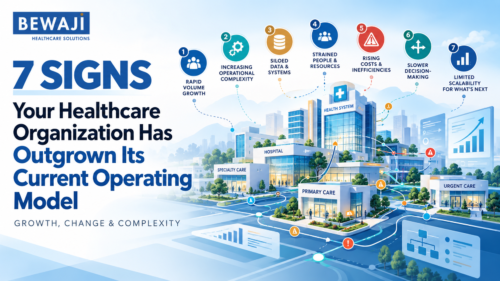
A healthcare organization has outgrown its operating model when growth makes it harder to control: routine decisions pile up on the owner, processes vary by person, managers firefight, technology fragments and leaders cannot see what is happening. One symptom alone may be a local problem. Several connected symptoms usually point to a healthcare operating model built for an earlier stage.
Growth rarely creates the weakness. Growth exposes roles, workflows, decision rules and management routines that worked at a smaller size and no longer fit. More staff, more software or more SOPs may treat the symptoms without fixing the structure.
Quick Summary: Signs a Healthcare Operating Model Has Been Outgrown
- A healthcare operating model is the combination of roles, workflows, decision rights, management routines, information, technology, standards, accountability and feedback that lets an organization deliver care and run the business reliably.
- An organization can have SOPs, software and experienced staff and still have a weak operating model, because documentation does not create operational control.
- Sign 1: routine decisions keep reaching the owner or senior leader.
- Sign 2: the same work is done differently depending on who does it.
- Sign 3: growth creates more coordination work than the organization can handle.
- Sign 4: managers solve recurring problems instead of managing performance.
- Sign 5: more technology is added, but work stays fragmented across workarounds.
- Sign 6: leadership cannot easily see what is happening operationally.
- Sign 7: every new service, site or hire causes disproportionate disruption.
- The strongest signal of an outgrown operating model is several of these signs appearing together, not any single one.
- The recommended response is to define the transition, protect critical services, map key workflows, design for the next operating state and sequence improvements rather than fix everything at once.
Why Growth Exposes Operating Model Problems
Growth exposes operating model problems because complexity rises faster than the systems that coordinate it. A healthcare organization can see rising patient volume, new providers, new services and growing revenue while leaders feel less in control. Typical symptoms include more issues reaching the owner, repeated questions from staff, inconsistent processes, managers firefighting, more patient complaints, information that is hard to obtain, and technology that does not make work easier.
Common first responses are hiring more people, replacing staff, buying another system or writing more SOPs. Each response can be right, but each can also treat a symptom while the cause remains. The underlying issue is often that the operation asks people to compensate for workflows, routines or tools that no longer fit the organization’s size.
What Is a Healthcare Operating Model?
A healthcare operating model is how an organization is set up to deliver care and run the business reliably, day after day. The healthcare operating model has eight working parts that must fit together:
- Roles and responsibilities: who does what and who owns the outcome
- Workflows: how recurring work moves from trigger to completion
- Decision rights: who can decide what without asking
- Management routines: regular reviews, huddles and follow-ups
- Information: what leaders and staff can see, and when
- Tools and technology: the systems the work runs through
- Standards and accountability: what “done well” means and who answers for it
- Feedback mechanisms: how problems surface and get fixed
Weakness in one part of the operating model shows up as strain in the others, which is why the warning signs tend to appear together.
Sign 1: Routine Decisions Depend on the Owner
Owner dependence means routine issues such as schedule changes, refunds, staffing, purchasing, vendor problems, complaints and exceptions keep reaching the founder, physician-owner, CEO or senior administrator. The leader becomes the organization’s informal routing system.
Owner dependence is usually systemic rather than a failure to delegate. The organization often lacks clear decision rights, capable managers with authority, escalation thresholds, accessible procedures and management information. In BHS work with a multi-provider healthcare practice, documenting processes alone did not reduce owner dependence; the practice also needed a stronger management layer with clear decision rights, recurring management routines and accountability for daily operating outcomes.
A practical fix is to sort common decisions into three categories:
- Decide: the manager handles it independently
- Consult: the manager seeks input but keeps responsibility
- Escalate: leadership approval is required
Diagnostic question: If the owner disappeared for two weeks, which routine decisions would stop moving?
Sign 2: Work Varies Depending on Who Does It
Process variation means patients get different experiences depending on location, shift, provider or staff member. Booking, follow-up, complaint handling, insurance verification, onboarding and inventory handling differ from person to person.
Informal coordination works at a small scale because people ask each other, the owner notices problems and new staff learn by watching. Informal knowledge stops scaling as teams grow, hiring speeds up, sites separate and handoffs multiply.
An SOP becomes part of the operating system only when it also has a trigger, a named owner, defined roles, decision rules, exception handling, escalation, measurement, appropriate tools, training and review. Not every process should be standardized; clinical and professional judgment should be protected. The target is unnecessary operational variation that creates patient risk, delays, rework, confusion, poor service or financial leakage.
Diagnostic question: Which recurring processes would produce noticeably different results if three different employees performed them tomorrow?
Sign 3: Growth Creates More Work Than the Organization Can Coordinate
Coordination overload means a growing organization becomes harder to manage: tasks stay incomplete, handoffs are missed, staff constantly chase each other, work disappears between departments and important tasks live in WhatsApp, email or memory.
Every new provider, location, service, payer, system, department or partner adds relationships and dependencies. Five people who must coordinate share 10 possible working relationships; fifteen people share 105. Coordination load rises much faster than headcount.
Transition capacity is an organization’s finite ability to absorb change. Transition capacity draws on leadership bandwidth, staff capacity, decision speed, management capability, technology support, data readiness and competing initiatives. A good opportunity can arrive when the organization cannot absorb it safely.
Signs of overloaded transition capacity:
- Meetings multiply while decisions slow
- Implementation deadlines keep moving
- One manager owns several major initiatives
- Staff are trained on new systems before earlier changes settle
- New initiatives start faster than old ones finish
- Temporary workarounds become permanent
Diagnostic question: How many major changes are competing for the same leaders, managers and frontline staff?
Sign 4: Managers Firefight Instead of Managing Performance
Manager firefighting means managers spend their time filling staffing gaps, answering routine questions, fixing schedules, chasing tasks, resolving repeat complaints and doing frontline work. Performance review, coaching, workflow improvement, metrics, planning and prevention get little time.
A manager who spends the whole day on operational tasks may hold a management title without the capacity to do management work. Building a true management layer means more than naming the most senior administrator as manager.
Protected management time is scheduled, recurring time for workflow review, KPI review, staff follow-up, complaints, outstanding tasks, inventory and schedule exceptions, and process improvement. Management work cannot depend on the clinic becoming quiet.
Diagnostic question: How much of your managers’ week is spent managing the operation rather than personally doing operational work?
Sign 5: More Technology, but Work Is Still Fragmented
Technology fragmentation means an organization has an EHR or practice-management system, scheduling, accounting, CRM, task tools, dashboards or AI tools, yet staff still rely on spreadsheets, paper, WhatsApp, duplicate data entry, manual reminders and workarounds.
Technology cannot repair an operating model that was never clearly designed, and sometimes technology simply digitizes fragmentation. BHS treats digital change as operating-model change enabled by technology, not software installation alone. The principle is to start with the problem and the workflow, not the tool.
For example, a clinic with poor patient follow-up should answer these questions before buying a new CRM:
- Who owns follow-up?
- Which patients need follow-up?
- When should contact happen?
- Where is the follow-up task created?
- What happens when the patient does not respond?
- How is completion recorded?
- Which exceptions are escalated?
Diagnostic question: How many important workflows cross several disconnected tools, spreadsheets, inboxes or paper processes?
Sign 6: Leadership Cannot See What Is Happening
Weak management visibility means leaders must ask people for information that should already be visible, such as patients waiting, no-show rates, stuck referrals, overdue work, unresolved complaints, under-capacity providers or locations, inventory shortages, revenue leakage and slipping milestones.
Late information forces leadership to manage in hindsight, when problems are already expensive. Management should move from activity tracking to outcome management: knowing 100 calls were made matters less than knowing how many patients were reached, how many appointments were recovered and what remains unresolved.
The management visibility stack has three levels:
| Level | Question it answers |
|---|---|
| Frontline | What needs attention today? |
| Manager | Where are the recurring exceptions and performance problems? |
| Executive | Are strategic, operational, financial and patient outcomes moving in the intended direction? |
Diagnostic question: Which important operational questions can leadership answer immediately without asking someone to assemble the information?
Sign 7: Every New Service, Site or Hire Causes Disruption
Disproportionate disruption means normal growth events destabilize operations: provider onboarding confuses scheduling, new locations develop their own practices, new services launch with unclear responsibilities, new staff are slow to become productive, and expansion increases owner involvement instead of reducing it.
The next operating state is the operating model the next version of the organization will require. Rather than enlarging the current system, leaders should design for it. A three-location organization may need central standards, local management authority, shared reporting, cross-site governance, standardized onboarding, common technology, escalation paths, unified inventory rules and consistent service expectations that a one-site practice did not.
The Protected Core is what must not deteriorate during a major transition: patient safety, critical clinical services, patient access, communication, scheduling continuity, billing and cash collection, privacy and security, staffing coverage and key integrations. Each protected area needs an owner, a standard, monitoring, escalation and a contingency.
Diagnostic question: What must keep working reliably while the organization is changing?
Isolated Problems vs. an Outgrown Operating Model
A single operational problem often has a local explanation, such as one weak manager, a temporary staffing shortage, a faulty system, an unusual demand spike or one broken workflow. The case for reviewing the healthcare operating model becomes stronger when several signs occur together. Owner dependence, inconsistent workflows, weak visibility, staff overload, technology workarounds and repeated implementation failures can be different expressions of the same structural issue.
Self-Assessment: Has Your Organization Outgrown Its Operating Model?
Answer each question Yes, Sometimes or No:
- Do routine operational decisions often reach senior leadership?
- Do different employees or sites perform important processes differently?
- Are managers often pulled back into frontline work?
- Does leadership struggle to get timely operational information?
- Do staff rely on workarounds despite having several digital systems?
- Are major initiatives repeatedly delayed or only partly adopted?
- Does every new provider, service or site cause significant disruption?
- Are responsibilities unclear when something goes wrong?
- Does performance depend heavily on a few experienced people?
- Would rapid growth expose weaknesses in current processes?
The self-assessment is not a scored or validated instrument. The value is in clusters: several related “yes” answers around ownership, workflow, management visibility or implementation identify an area worth investigating.
Common Mistakes When an Operating Model Has Been Outgrown
- Hiring into the gap, which adds coordination inside an unclear structure
- Writing SOPs without owners, measures or review
- Buying software to fix a workflow problem
- Promoting a manager without protected time or authority
- Fixing everything at once and exhausting transition capacity
- Designing improvements for today’s size instead of the next stage
How to Respond to an Outgrown Healthcare Operating Model
Responding to an outgrown healthcare operating model means sequencing the work rather than fixing everything at once. The six steps are:
- Define the transition: growth, a new location, provider expansion, an acquisition, a technology implementation, a new service or a leadership change.
- Identify what is under strain: workflows, roles, management, technology, data, staffing, patient experience and financial processes.
- Name the Protected Core: what must keep working while changes are made.
- Map the operating system for key workflows: owner, roles, process, decisions, exceptions, tools, data, measures and escalation.
- Design for the next operating state: plan for what the organization is becoming, not only current conditions.
- Sequence improvements: classify issues as blockers (prevent safe or effective progress), accelerators (make several other improvements easier) or optimizations (useful but not urgent), then place them into Now, Next and Later.
The governing principle is that growth should increase an organization’s capability, not its dependence on heroics. When growth makes an organization steadily harder to control, the next investment may need to be a redesign of how work is coordinated, managed and measured rather than another hire or another piece of software.
FAQ: Healthcare Operating Model Warning Signs
What is a healthcare operating model?
A healthcare operating model is the combination of roles, workflows, decision rights, management routines, information, technology, standards and accountability that lets an organization deliver care and run the business reliably. The healthcare operating model describes how work is actually coordinated, not just how it is documented. Two organizations with the same software and SOPs can have very different operating models.
How do I know if my practice has outgrown its operating model or just has growing pains?
Growing pains are usually temporary and isolated, while an outgrown operating model shows up as several connected problems that persist. When owner dependence, inconsistent workflows, overloaded managers and poor visibility appear together and keep returning, the structure itself is likely the issue. A single problem with a clear local cause usually is not.
Can SOPs fix an outgrown operating model?
SOPs alone rarely fix an outgrown operating model. An SOP becomes part of the operating system only when it has a trigger, an owner, decision rules, exception handling, escalation, measurement, training and regular review. Without those elements, documented processes tend to drift back to old habits.
Should a healthcare organization buy new software when workflows are fragmented?
New software should not be the first step when workflows are fragmented. Leaders should first define the workflow, its owner, its decisions and where it fails, then check what existing tools already do. Technology helps most once the operating problem is clear; before that, it often moves the same fragmentation into a new system.
What is transition capacity in a healthcare organization?
Transition capacity is the amount of change a healthcare organization can absorb at once without losing control. Transition capacity depends on leadership bandwidth, staff capacity, decision speed, management capability, technology support, data readiness and competing initiatives. Overloaded transition capacity shows up as slowing decisions, moving deadlines and workarounds that become permanent.
When should a growing healthcare organization review its operating model?
The best time to review a healthcare operating model is before a major transition, such as a new location, several new providers, a new service line or a technology replacement. A review is also worth considering when several warning signs appear together. Reviewing early lets leaders protect critical services while the organization changes.