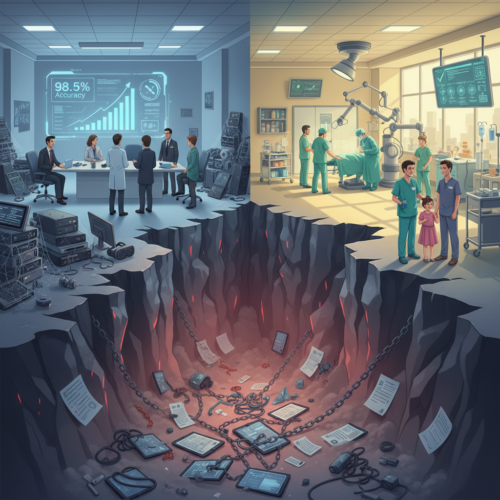
If your clinic runs smoothly only when a few “hero” staff members are on shift—or when leadership is constantly putting out fires—you don’t have a clinic operating system. You have effort holding things together.
Healthcare leaders often equate “operations” with a new EHR, a scheduling tool, or a few policies in a shared folder. These are fragments, not systems. In real clinics, the biggest breakdowns come not from missing software but from friction between space, workflows, staffing, and information—creating delays, handoff errors, bottlenecks, and inconsistent patient experiences that erode both quality and morale.
A Clinic Operating System is the clinic’s full operating blueprint: a coordinated system that integrates physical design, standardized processes, technology and data infrastructure, staffing models, and a management cadence so that quality and throughput don’t depend on constant leadership intervention. When these pieces work together, clinics reduce friction, protect quality and safety, and stop relying on firefighting.
This post defines what a clinic operating system is and what it is not, then shows what it looks like in real life across physical workflow and space, standardized processes and delegation, digital and data infrastructure, staffing and resource planning, patient engagement, advanced real-world examples, and continuous improvement. By the end, you’ll understand the core building blocks you can implement: patient flow design, standard operating procedures with escalation paths, integrated data and dashboards, predictive scheduling and capacity management, patient engagement systems, and continuous improvement cadences.
Too long? Find the TLDR version here
What a Clinic Operating System Is—And Why It’s More Than Software
A clinic operating system combines physical space design, standardized processes, technology stack, staffing models, and management cadence into one coordinated system. It is not a single app. It is not just an EHR, not just policies, not just a scheduling template. Those are components, not the system itself.
The systems mindset means every component reinforces the same patient journey and operational outcomes. Consider the difference between a well-designed railway system and a collection of trains. The trains matter, certainly. But without coordinated tracks, signals, schedules, and maintenance protocols, those trains cannot deliver passengers reliably from origin to destination. The clinic operating system functions similarly—it’s the entirety of how the clinic works, not merely the tools it uses.
Why do clinic operating systems exist at all? They exist to reduce operational friction: the delays, handoff errors, bottlenecks, rework, and those frustrating “where is that information?” moments that plague disjointed operations. They protect clinical quality and safety by making the right action the easy default through standard work and visibility. And they free leaders from constant triage by shifting routine resolution to repeatable workflows with clear ownership.
How does a clinic operating system show up in real life? Patients feel it as a smooth, predictable visit—clear steps, fewer surprises, less waiting. Staff experience repeatable workflows and fewer interruptions, which reduces cognitive load and eliminates workarounds. Leaders see reliable metrics, accountability, and fewer escalation requests for routine problems. The difference is palpable, measurable, and sustaining.
The core building blocks that create this coherence include patient flow design that maps and optimizes the end-to-end journey, standard operating procedures paired with escalation paths that define standard work and decision rights, integrated data and operational dashboards that provide visibility and control, predictive scheduling and capacity management that match the right care with the right time and resources, patient engagement systems that reduce no-shows and confusion through clear communication, and continuous improvement cadences that measure performance, iterate solutions, and maintain governance.
These building blocks don’t function in isolation. They reinforce one another, creating a system where each improvement amplifies the others.
Physical Workflow and Space Organization: The Operating System Is Visible in the Layout
If the clinic operating system is the blueprint, the first place you can see it is in the building itself. Layout either supports flow or creates friction. There is no neutral ground.
Designing for patient flow begins with mapping the full journey: entrance to registration, registration to waiting, waiting to exam and diagnostics, diagnostics to treatment, treatment to checkout and exit. Each transition point represents an opportunity for efficiency or delay. Zoning spaces to match this flow minimizes unnecessary movement and confusion for both patients and staff. Typical choke points reveal themselves quickly—registration backups when two patients arrive simultaneously, room availability constraints during peak hours, diagnostic handoffs that require patients to navigate unfamiliar corridors, checkout delays when billing questions arise without adequate space or privacy.
Separating public zones from staff-only zones reduces interruptions and safety risks. Public zones—lobbies, waiting areas, patient-facing pathways—should be designed for clarity and calm. They guide patients intuitively through each step. Staff-only zones—sterile processing, supply rooms, staff lounges, lockable storage—are designed for reliability and control. This separation delivers operational payoffs: fewer interruptions during critical tasks, better infection control practices, fewer lost supplies and the informal “borrowing” behavior that disrupts inventory management.
Building logistical pathways that keep operations moving without congesting care areas requires planning service corridors and delivery access to streamline supplies and specimen transport. Drop-off and parking patterns, when designed thoughtfully, reduce late arrivals and entrance congestion. Preventing cross-traffic between patients, supplies, and back-of-house tasks supports both throughput and safety.
Real-world design cues signal a mature clinic operating system. Daylight-filled interiors and intuitive navigation reduce the wayfinding burden on anxious patients. Central “organizing hubs”—large, well-lit lobbies that make routing clear—support higher throughput without creating confusion. Design is not merely aesthetic. It is an operational tool to reduce friction in every step of the journey.
Consider the San Blas Healthcare Center in Madrid. Despite offering high-complexity services including laboratories, pharmacy, operating rooms, and a linear accelerator, the center remains remarkably patient-friendly. Functional zoning and coordinated pathways reduce confusion despite the breadth of services. Complexity, it turns out, requires clearer system design, not more ad hoc coordination.
Process Management and Delegation: Standard Operating Procedures and Escalation Paths Keep Leaders Out of the Weeds
A great layout helps. But it cannot compensate for inconsistent execution. The next layer of the clinic operating system is standard work—ensuring that quality and efficiency don’t depend on who happens to be working.
Standardizing repeatable work with standard operating procedures means documenting core operational workflows: check-in and check-out, rooming sequences, referral processes, prior authorization protocols, inventory management, incident reporting. Each procedure should define what “done” looks like with clear criteria: the required inputs, the steps to complete them, the expected outputs, and the handoff points to the next stage. This reduces variation that causes downstream errors—missing documentation, incomplete referrals, billing rework, delayed care.
Creating clear decision rights prevents everything from landing on the owner’s desk. Define what frontline staff can resolve independently, what supervisors own, and what escalates to management or the medical director. Build escalation paths with explicit thresholds: time constraints, safety risks, patient complaint severity, compliance triggers. This structure increases both speed and fairness. Consistent decisions reduce perceived favoritism and eliminate repeated debates over the same issues.
Systematizing urgent but not important issues—tardiness, minor scheduling disputes, routine complaints, low-level service recovery—uses predefined steps and scripts to resolve problems quickly without ad hoc leadership intervention. This separates noise from signal, reserving leadership attention for safety, compliance, and systemic performance problems that genuinely require executive judgment.
Training and empowering supervisors as the clinic operating system’s operators equips mid-level leaders with tools, scripts, and authority to solve problems quickly. This ensures consistency and fairness: the same issue receives the same resolution pathway regardless of the day or supervisor on duty. It builds a culture of ownership where supervisors become the first-line stabilizers of throughput and experience, rather than escalation points that merely funnel problems upward.
At the Chaum Anti-Aging Life Center in Seoul, a hybrid model combining advanced diagnostics with ongoing connected health services demonstrates how standard work and clear delegation enable complex operations. Privacy-forward consultation spaces—private “cells” designed for sensitive discussions—support patient comfort without creating operational chaos. The lesson is clear: patient experience and clinical throughput can coexist when spaces and workflows are intentional rather than improvised.
Digital and Data Infrastructure: One Ecosystem for Care, Operations, and Communication
Standard work creates consistency. But reliability scales only when information moves cleanly. The clinic operating system needs an integrated digital and data layer that connects care, operations, and communication seamlessly.
Centralizing information with an EHR and integrated tools reduces missed handoffs. Connecting scheduling, documentation, e-prescribing, billing, and reporting workflows eliminates duplicate entry and the fragmentation that drives errors and delays. Treat integration as an operational safety measure—handoff reliability—not just an IT preference. When information exists in multiple disconnected systems, handoffs become translation exercises. Translation introduces error.
Operational visibility in real time through dashboards and analytics enables capacity management. Use dashboards to monitor bottlenecks: room turnover rates, lab processing delays, queue lengths, cycle times from arrival to discharge. Apply modeling and simulation concepts to test throughput changes before rolling them out clinic-wide. Use control charts to distinguish normal variation from systemic drift or special-cause events that require intervention.
Automating patient communication reduces no-shows and standardizes education. Appointment reminders, preparation instructions, and follow-up messages reduce no-shows and improve visit readiness. Standardizing patient education content reduces variability across staff members and communication channels. This decreases inbound phone volume by answering common questions proactively, freeing staff to handle complex inquiries that genuinely require human judgment.
Proactive care using AI and IoT, where appropriate and without overcomplicating operations, includes remote monitoring through wearables, blood pressure cuffs, and glucose devices for chronic disease management. These tools trigger earlier outreach based on thresholds and trends, reducing avoidable visits and emergency interventions. Integrate alerts into workflows so signals become actionable tasks with clear ownership rather than notifications that disappear into inboxes.
The Cleveland Clinic Lou Ruvo Center for Brain Health demonstrates how unified management systems support multiple missions—clinical care, research, events, and fundraising—without mission sprawl disrupting clinical operations. Clear functional zoning and integrated data systems prevent research activities from creating bottlenecks in patient care. Governance and zoning, it becomes clear, are essential when the clinic serves multiple purposes.
Staffing, Resource Planning, and Supply Chain: Match Capacity to Demand Without Burnout
Data visibility is valuable only if you can act on it. That means matching staffing, rooms, and supplies to demand so the clinic runs predictably without burning people out.
Forecasting demand using historical trends and clinical guidelines predicts patient volumes, visit types, and resource needs. Apply clinical guidelines to estimate time and support requirements by visit type. Translate forecasts into appointment templates and staffing plans that reflect reality rather than wishful thinking. A template that schedules twenty-minute appointments for procedures that consistently require thirty minutes creates cascading delays and staff frustration.
Building schedules that balance coverage, throughput, and workload means aligning clinician, medical assistant, nursing, imaging, laboratory, and front-desk staffing with peak demand times. Reduce wait times and overtime by matching staffing to the true constraint in the system. Use predictive scheduling concepts to protect access while maintaining care quality. This is not about working faster—it’s about working smarter by removing the structural mismatches that create unnecessary pressure.
Reducing burnout through smarter allocation and targeted fixes uses data to identify chronic overload points. Monday morning surges, for instance, often result from weekend appointment backlogs. Redistribute tasks, add float coverage, or adjust templates to stabilize workload. Protect staff well-being as an operational metric that impacts safety, turnover, and patient experience. Burned-out staff make errors, leave the organization, and cannot deliver the consistent care that patients deserve.
Automating replenishment and inventory controls prevents last-minute shortages that disrupt clinical flow. Implement inventory controls for critical supplies and medications. Automate replenishment to reduce manual tracking errors and urgent procurement that inevitably costs more. Link supply visibility to service lines and usage patterns to improve forecasting accuracy. When supplies run out during a procedure, the delay affects not only that patient but every patient scheduled afterward.
Healthcare operations management, when done well, feels invisible to patients. They simply experience a clinic that works.
Patient Engagement and Experience: Operational Excellence Should Feel Clear and Patient-Centered
Operational strength should feel calm to patients. The clinic operating system isn’t complete unless engagement tools and service design reduce confusion, anxiety, and missed care.
Improving wayfinding reduces stress, late arrivals, and front-desk burden. Use consistent signage and intuitive layouts to reduce confusion. Late arrivals and misdirected patients disrupt schedules for everyone who follows. Treat wayfinding as a throughput lever, not just a facilities detail. When patients can navigate confidently from parking to their destination, check-in proceeds smoothly and appointment times hold.
Designing comfort into throughput acknowledges that efficiency doesn’t have to feel rushed. Comfortable waiting areas support satisfaction even when demand is high. Biophilic elements—natural light, plants, views of greenery—reduce perceived stress during unavoidable waits. Align environment with flow so comfort doesn’t create congestion. A beautiful waiting room that sits between registration and exam areas without adequate square footage becomes a bottleneck, not a benefit.
Creating structured feedback loops with clear routing and ownership means collecting feedback consistently via post-visit surveys, kiosks, or portal prompts. Route feedback to specific owners with timelines and action plans. Close the loop by communicating changes and tracking impact over time. Patients who take the time to provide feedback deserve to know their input mattered. This builds trust and surfaces improvement opportunities that leaders, insulated from daily patient interactions, might otherwise miss.
Connecting engagement tools to operations reduces phone volume and missed care. Use portals and messaging for preparation instructions, results communication, and follow-up plans. Standardize communication pathways to reduce dropped messages and duplication. Shift routine coordination away from phone dependence toward trackable workflows. When a patient calls to ask a question that should have been answered in their discharge instructions, the problem isn’t the patient—it’s the system.
Improving patient engagement and improving patient outcomes are not separate goals. They are linked. Engaged patients who understand their care plans, receive timely communication, and can navigate your facility without stress are more likely to adhere to treatment, attend follow-up appointments, and achieve better health outcomes.
What Advanced Clinic Operating Systems Look Like in Practice: Real Clinic Examples of Integration
It’s easier to understand a clinic operating system by seeing full integration in real clinics where design, technology, staffing, and governance all reinforce the same patient journey.
The San Blas Healthcare Center in Madrid organizes complexity into a coherent patient journey. High-complexity services—laboratories, pharmacy, operating rooms, a linear accelerator—could easily create chaos. Instead, functional zoning and coordinated pathways make the experience patient-friendly despite the service breadth. The operational lesson is straightforward: complexity requires clearer system design, not more ad hoc coordination. When every component understands its role within the larger system, complexity becomes manageable rather than overwhelming.
The Chaum Anti-Aging Life Center in Seoul combines high-tech diagnostics with connected health services in a privacy-forward environment. Private consultation “cells” support patient comfort during sensitive discussions while maintaining clinical throughput. The hybrid model demonstrates that patient experience and clinical efficiency are not trade-offs—they are complementary when spaces and workflows are designed intentionally. The center doesn’t sacrifice efficiency for comfort or comfort for efficiency. It achieves both through design that serves both purposes simultaneously.
The Cleveland Clinic Lou Ruvo Center for Brain Health supports multiple missions—clinical care, research, events, fundraising—through unified systems. Multi-mission operations could easily create mission sprawl that disrupts clinical work. Clear functional zoning prevents this. Unified management systems ensure research activities, fundraising events, and patient care proceed without interfering with one another. The governance structures that enable this aren’t afterthoughts—they’re foundational to the center’s design.
The key takeaway from these advanced examples is that “advanced” isn’t luxury. It’s intentional integration. The building, workflows, staff roles, and data systems reinforce the same patient journey. High performance comes from coherence and repeatability, not just premium finishes or additional technology. Readers can apply the same principles at any clinic size by aligning components to flow and metrics rather than accumulating disconnected improvements.
Continuous Improvement and Quality Control: The Operating System Must Evolve Through Measurement and Iteration
Even a well-designed clinic operating system will drift without measurement. The final layer is continuous improvement—how you keep the system current as demand, staff, and services change.
Running improvement projects tied to real operational pain points means targeting measurable issues: delayed lab results, long rooming times, high no-show rates. Use structured tests of change to avoid large disruptive rollouts that don’t stick. Define outcomes and owners before changes are implemented. What does success look like? Who maintains the new process once the project ends? Without clear answers to both questions, improvements fade as soon as attention shifts elsewhere.
Using control charts and operational metrics manages variation over time. Track performance to separate one-off disruptions from systemic problems. Verify whether changes produced sustained improvement, not just short-term gains. A process that improves dramatically for two weeks then reverts to baseline didn’t improve—it experienced temporary variation. Use data to trigger intervention thresholds before issues become crises. Early warning systems prevent small problems from becoming large ones.
Aligning clinical and business goals with dashboards and scorecards combines access, quality, safety, patient experience, staff health, and financial indicators. Avoid optimizing one area at the expense of another. Throughput gains that harm safety or staff retention aren’t gains—they’re transfers of cost from one area to another. Create shared definitions and cadence so leaders and teams interpret metrics consistently. When everyone defines “on-time start” differently, comparing performance across departments becomes meaningless.
Institutionalizing review cycles keeps the clinic operating system alive. Schedule recurring huddles for near-term operations and rapid issue resolution. Monthly or quarterly reviews assess metrics, incorporate feedback, and prioritize improvements. Update standard operating procedures, staffing plans, and templates as the clinic learns and demand shifts. The system that worked last year may not serve this year’s patient population or service mix. Adaptation isn’t optional—it’s essential.
Healthcare workflow optimization isn’t a project with an end date. It’s an ongoing discipline.
Common Questions About Building a Clinic Operating System
How long does it take to build a functional clinic operating system?
Building a complete clinic operating system typically takes six months to two years, depending on clinic size and current state. However, you can begin seeing improvements within 30 to 90 days by implementing one building block at a time. Start with the highest-impact area—often patient flow design or standardizing one critical process—and build from there. The system evolves through iteration, not through a single comprehensive rollout.
Do we need to replace our current EHR to build a clinic operating system?
No. A clinic operating system works with your existing technology stack. The focus is integration and workflow optimization, not necessarily replacing tools. Many clinics discover their current EHR can do more than they’re using it for once workflows are standardized and staff are properly trained. That said, if your EHR creates more friction than it resolves, the operating system work will help you define requirements for a replacement based on actual workflow needs rather than vendor features.
How do we get staff buy-in for standardized processes?
Involve frontline staff in designing the standard operating procedures. The people doing the work daily understand the practical constraints better than anyone. When staff help create the standards, they’re more likely to follow them. Additionally, demonstrate how standards reduce their cognitive load and interruptions rather than adding bureaucracy. Standards should make their work easier, not harder.
What metrics should we track first?
Begin with patient flow metrics: arrival-to-rooming time, room turnover, cycle time from arrival to discharge, and appointment adherence (both provider and patient). These metrics quickly reveal bottlenecks and provide clear improvement targets. Add clinical quality and safety metrics, patient experience scores, and staff satisfaction measures as your system matures. Avoid tracking too many metrics initially—choose five to seven that directly relate to your current pain points.
Can a small clinic benefit from a formal operating system, or is this only for large organizations?
Small clinics often benefit more than large ones because improvements are easier to implement and results appear faster. The principles scale to any size. A three-provider practice still needs clear patient flow, standardized processes, integrated information, and capacity management. The documentation may be simpler and the technology less complex, but the fundamental building blocks remain the same. Small size is an advantage, not a limitation.
How do we balance standardization with the flexibility to handle unique patient situations?
Effective standard operating procedures include escalation paths and exception handling. The standard covers the 80 to 90 percent of routine situations. For the remaining cases, clear decision rights define who can deviate from standard and under what circumstances. Standards reduce variation in routine work so that staff have more mental capacity and time to handle genuinely complex situations that require customization.
Building Your Clinic Operating System: Where to Start
A real clinic operating system is a coordinated blueprint that shows up in the physical layout, repeatable standard operating procedures and escalation paths, integrated digital and data infrastructure, demand-matched staffing and supply chain, patient-centered engagement, and a continuous improvement cadence. When these pieces reinforce the same patient journey, clinics reduce friction, protect quality and safety, and stop relying on constant leadership firefighting.
The most effective clinic operating systems aren’t defined by luxury finishes or the newest tool. They’re defined by intentional integration, where the environment, workflows, roles, and data all work together to make excellent care feel calm, consistent, and scalable.
Begin by auditing your current state. Map one patient journey end-to-end and identify where flow breaks: gaps in space utilization, handoff failures, staffing mismatches, data visibility problems, communication breakdowns. Then choose one building block to implement in the next 30 days. Standardize one high-volume standard operating procedure. Launch a simple throughput dashboard. Redesign a scheduling template based on demand trends rather than historical habit.
Each improvement builds momentum. The clinic that can reliably deliver excellent care today is the clinic that invested in systems rather than heroics.
Ready to Build Your Clinic Operating System?
Developing a comprehensive clinic operating system requires a clear roadmap. We’ve created a detailed 20-page guide that walks you through each building block, providing frameworks, templates, and implementation steps you can use immediately.
Download the Complete 6-Week Clinic Operating System Roadmap
This roadmap includes:
- Week-by-week implementation plans for each building block
- Assessment tools to identify your highest-impact starting point
- Standard operating procedure templates
- Dashboard and metrics frameworks
- Staffing and scheduling optimization worksheets
- Patient engagement checklists
- Continuous improvement protocols
Stop firefighting. Start building systems that work.
Bewaji Healthcare Solutions helps healthcare organizations design and implement clinic operating systems that reduce friction, protect quality, and free leadership from constant crisis management. Learn more about our systemization programs and operational improvement services at bewajihealth.com.