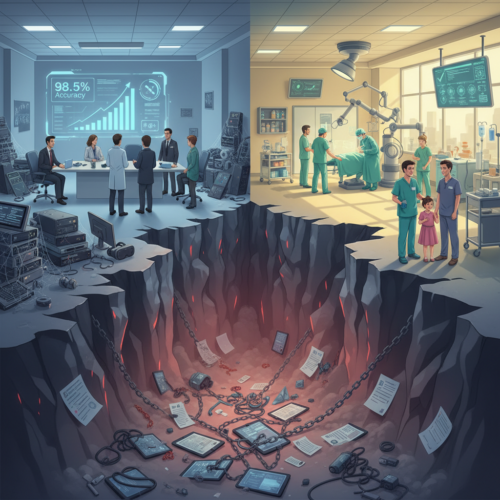
The Core Problem: If your best people constantly rescue operations through heroics, your operating system is broken. Hard work cannot overcome poor workflow design, unclear ownership, and missing feedback loops.
The Bottom Line: Effort alone creates waste when the system is flawed. Only redesigned processes—supported by standard work, integrated tools, and operational governance—convert staff energy into reliable patient care.
What a Broken Operating System Looks Like
Healthcare operations fail when improvisation replaces reliable processes:
- Unclear ownership at handoffs creates duplicated work and missed tasks
- Fragmented IT systems force re-entry, manual reconciliation, and shadow tracking
- Unreliable equipment availability drives constant searching and last-minute substitutions
- Missing feedback loops prevent learning from recurring defects
- Inconsistent processes make safety and quality vary by shift, unit, or individual
The real workflow becomes whatever staff invent to survive—invisible to leadership and impossible to scale.
Why Effort Fails: System Design Determines Waste
Value-added work includes direct patient care and accurate clinical decisions. Non-value-added work includes searching for supplies, re-entering data, and correcting recurring errors.
Broken systems inflate waste, draining capacity needed for access, quality, and staff development.
The Ceiling Effect
Even exceptional staff cannot overcome bottlenecks:
- A surgeon can’t operate without the correct instrument set
- Nurses rewriting documentation lose hours without improving outcomes
- Manual rework reduces time for patient education and safety checks
Bottlenecks cap throughput and quality regardless of effort. Pushing harder increases error risk and burnout without durable gains.
Evidence: Redesign Beats Heroics
Advanced access scheduling reduces wait times through redesigned appointment templates and demand smoothing—not by asking staff to double-book and stay late.
The “just work harder” failure mode: Short-term throughput rises when staff skip breaks and stack visits. Defects rise simultaneously: delays, missed follow-ups, patient dissatisfaction, and rework.
Process improvement cautionary tale: The telecom company 1&1 created thousands of process models with high enthusiasm. Without governance, standards, and quality checks, the effort produced administrative chaos rather than clarity.
The lesson: Activity isn’t improvement. Healthcare leaders need system rules—naming conventions, version control, approval pathways, auditing—plus enablement through training and tools.
Organizational Costs of Heroics
Burnout and Turnover
Chronic overextension and moral distress drive attrition—even among top performers. Turnover amplifies instability and increases operational variation.
Inconsistent Quality
Outcomes fluctuate based on who is working. Error risk increases when critical steps depend on memory and tribal knowledge.
Normalized Rework
Recurring problems consume capacity and hide true demand. When follow-up calls address prescription confusion from poor discharge processes, the call center appears understaffed. The real problem is upstream.
Eroded Trust
When leadership thanks staff for working harder instead of removing barriers, staff conclude problems won’t be fixed. Disengagement reduces improvement participation and accelerates turnover.
Leadership Playbook: Fix the System First
1. Streamline and Standardize Workflows
- Map end-to-end processes (referral-to-visit, discharge-to-follow-up)
- Remove unnecessary steps and define clear ownership
- Standardize handoffs to reduce variation
2. Automate and Integrate High-Friction Tasks
- Eliminate duplicate documentation and manual data transfer
- Automate reminders, routing, and reconciliation
- Target top time thieves: re-entry, searching, manual tracking
3. Build Feedback Loops Using Data
- Monitor cycle time, rework rates, defect types
- Review metrics with process owners and frontline staff
- Close loops quickly with visible fixes
4. Use Checklists and Protocols
- Implement pre-op checklists, discharge checklists, medication reconciliation protocols
- Create escalation pathways so safety doesn’t depend on memory
- Standardization reduces variation while preserving clinical judgment
5. Train and Empower After Removing Barriers
- Pair skill-building with right tools and decision rights
- Avoid training without enablement—staff can’t apply what they can’t access
- Embed new standard work through role-based training
Create a No-Blame Improvement Culture
Make defect reporting safe: Treat missing supplies, IT failures, and unclear policies as improvement signals, not personal shortcomings.
Shift from person-focused to process-focused: Use root cause analysis and “5 whys” to prevent recurrence. Stop rewarding heroics as the primary success path.
Make improvements visible: Communicate what was raised, what changed, and what impact occurred. Close loops quickly to build trust.
Reward system improvement: Celebrate teams for reducing rework and standardizing processes—not for enduring dysfunction.
Core Principle: Good Systems Amplify Good People
Talent and effort can’t overcome systemic bottlenecks. Well-designed processes convert staff energy into reliable outcomes. A stable operating system reduces dependence on memory and exception-handling.
Success looks like:
- Fewer workarounds as systems become dependable
- Less rework as problems get prevented
- More time in value-added care
- Consistent outcomes regardless of who is on shift
What to Do Tomorrow
- Audit where heroics are required in your operation (handoffs, scheduling, supplies, documentation)
- Pick one high-friction workflow to map with frontline staff
- Clarify ownership at each step
- Remove obvious rework (duplicate approvals, unnecessary steps, information gaps)
- Instrument the process with key measures (cycle time, defect frequency)
- Commit to closing loops on defects within a defined cadence (weekly review, monthly fixes)
The goal isn’t asking more from hardworking teams. The goal is building an operating system that stops wasting their effort and turns it into dependable care, every shift.
Discover why your clinic feels stuck in daily firefighting. Take a 5-minute scorecard to identify bottlenecks and regain operational control.
Quick FAQ
How do I know if my operating system is broken?
The same problems recur weekly, workarounds become standard practice, and performance varies dramatically based on who is working. If staff can predict which problems will occur each shift, you’re seeing system failure.
Won’t standardization reduce clinical judgment?
Standardization applies to processes, not decisions. It ensures complete information reaches clinicians—they still exercise judgment about care. Effective standardization removes waste while preserving meaningful clinical variation.
How can we change when we’re already overwhelmed?
Start small with one high-impact workflow. Map current state, remove top waste drivers, measure improvement. Success builds capability for broader changes. Trying to fix everything simultaneously produces incomplete results.
What if staff resist workflow changes?
Involve frontline staff in design from the start. Test in small pilots. Address workload concerns during transition. Most importantly, demonstrate that changes reduce burden. Staff embrace redesign when they experience less rework and more time for patient care.